

For more than three decades, Danny Clinch has helped define how we see the music we love. His photographs are living documents of artists in their element—images that become inseparable from the songs, the albums, and the eras they helped shape.
From the earliest days of rock, photographers like Jim Marshall, Henry Diltz, and Mick Rock got up close and personal with the artists. They didn’t just document a band, they became participants—more than a fan and less than a member—capturing the moments in between. That’s where the magic happens. Danny carries on that tradition.
His signature style blends raw intimacy, analog grit, and a musician’s-eye understanding of performance and personality. He favors film’s honest imperfections, letting light leaks, shadows, and grit become part of the storytelling. The resulting images are unguarded and human.
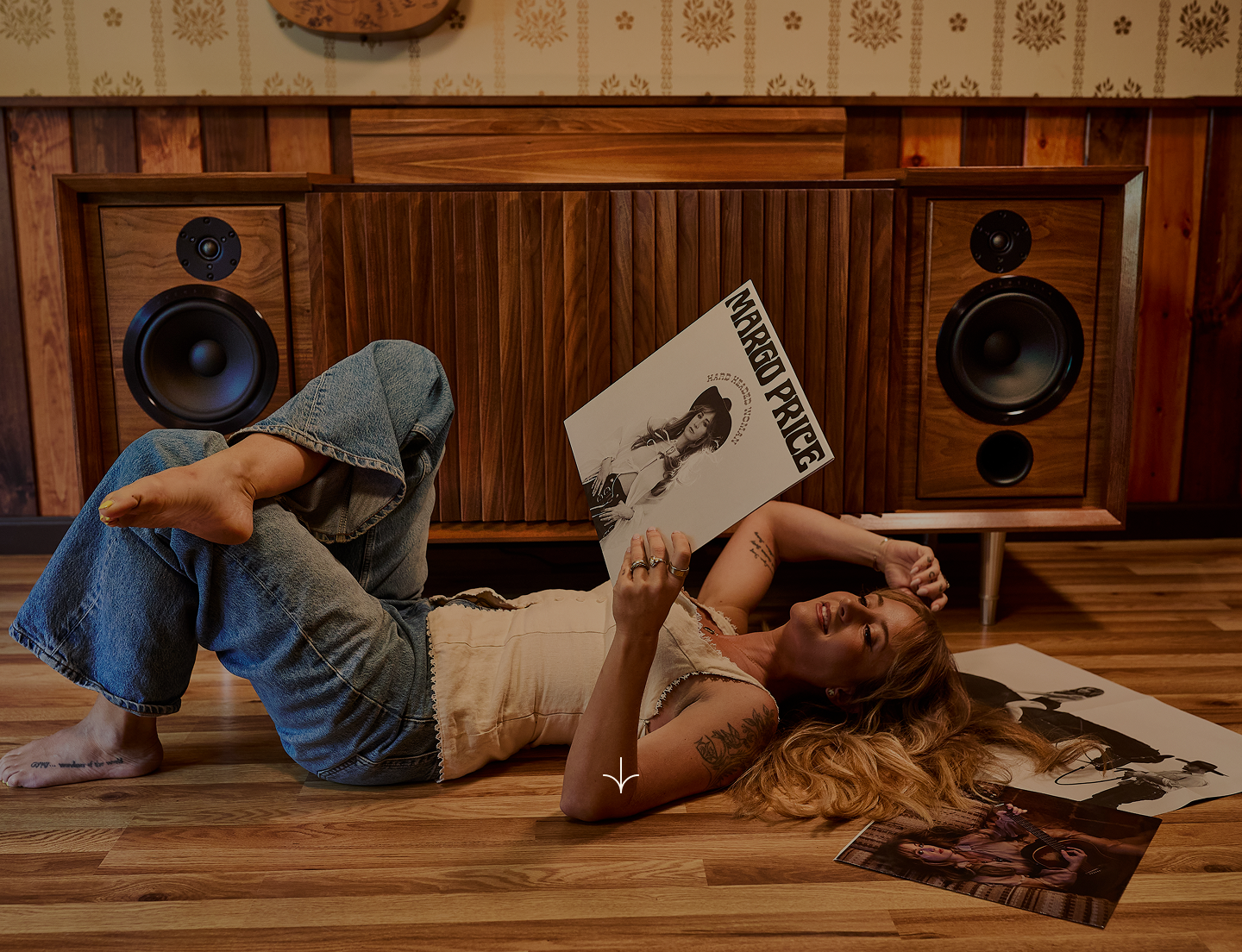
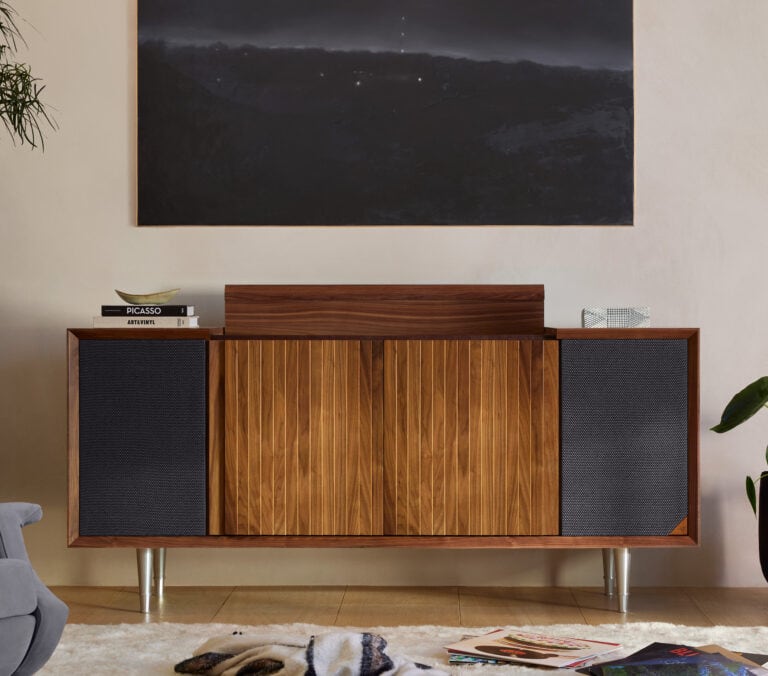
Wrensilva Presents: The Art of the Album - The Photography of Danny Clinch installation invites you to step inside that relationship. Here, Clinch’s iconic images are presented alongside the album covers that immortalized them and the vinyl itself, played on a Wrensilva record console. This installation is not only about looking at photographs. It is about standing in the same space as the music that made them legendary.
Experience the installation at the Wrensilva LA Listening Studio,
8625 Melrose Ave., Tuesday-Saturday between 11 a.m. and 5 p.m., through spring 2026. Presented in collaboration with Danny Clinch, Transparent Clinch Gallery, and Adler Smith Gallery.
In anticipation of The Art of the Album, we spoke with Danny about the nine iconic album covers that feature his photography.


Blind Melon - Soup
Blind Melon’s second studio album was released in 1995. It was recorded in New Orleans, but Danny’s cover photo was taken in an old diner in midtown Manhattan.
“I think we took those photographs on the SE Corner of 11th and 37th Street in NYC. It was a rundown little diner,” Danny recalls. “ It was the very first time that I worked with a food stylist. We had to spell out the album title and make sure the letters stood out. The man in the photo is the album’s producer, Andy Wallace. The band wanted it to feel real, like someone was just having a bowl of soup. I would argue that it’s one of the great records to come out of that era.”


Foo Fighters - There Is Nothing Left To Lose
For the Foo Fighter’s third album in 1999, the band went back to Dave Grohl’s roots. The cover photo is a black-and-white image of the back of Grohl’s neck with his Foo Fighters logo tattoo.
“This was one of the great photo shoots for me,” Danny says. “They were recording the record in Virginia. I spent three or four days there. We hung out and had barbecues and just had a great time. Dave had short hair at the time, and he had just gotten that tattoo, and I thought it would make a really dynamic image.”
The grittiness of the photo and the raw edges of the frame around it come courtesy of the Mamiya RZ67. Danny explains, “It was a medium format camera—one of the largest of the medium format cameras. I often used it specifically for shooting Polaroids. There was a Polaroid film back in the day called Type 665. You could get a positive from it, and you could also get a negative by putting the back part that you might normally throw away into a chemical solution. The resulting image was very sharp but soft at the same time, and it had that natural frame.”


Johnny Cash - American III: Solitary Man
Johnny Cash worked with Rick Rubin on his final series of albums before his death in 2003. American III: Solitary Man was the third in the series and the penultimate studio album to be released during Cash’s lifetime. Though the album was released in 2000, Danny captured the perfect cover image six years before.
From a previous interview, Danny says, “This photo became so much more than a portrait for me. It was a moment that happened. It's something you can't plan. I had his undivided attention for an hour to do these portraits, and in the end, it was when I let him go that I got the shot.”
It was 1994, and Danny was photographing Johnny Cash for the cover of an acoustic guitar magazine before a show in Long Island, NY. There he was, standing in the hallway while onstage he was being introduced. I can hear it now: ‘Ladies and gentlemen, The Man in Black…’ I felt like I was invisible, and I just snapped it.”
Danny later sent Rick Rubin a print of that photo as a thank-you for making the American Recordings albums with Johnny. Danny told him, “It really means a lot to me. Thank you for bringing him back into the mix for everyone.” Rick hung the photo in his studio. As they were finishing Solitary Man, people would walk by the photo and say, “That's the Solitary Man photo right there." Danny recalls, “Rick was like, ‘Yeah, it is.’ And then he called me and asked if I had any more photos.”


“I'm documenting music because I’m obsessed with it. I feel compelled to document the people who mean so much to others.”
2Pac - Until the End of Time
Released in 2001, five years after Tupac’s death, Until the End of Time features a Vicki Berndt painting based on Danny’s legendary photograph— an image that feels like it has always existed. Flash back to 1993 and Danny’s first assignment for Rolling Stone. His subject: Tupac Shakur.
Danny sets the scene: “He had a record coming out, and I think he understood the impact of a hip-hop artist getting Rolling Stone coverage. Tupac came by himself with one other guy. He showed up on time, and he was prepared.”
“I was using a large-format camera at the time. I was inspired by the simplicity of Richard Avedon and Irving Penn. I always move so fast—I'm dancing around, click-click-click. I wanted to slow down and keep it simple. Tupac brought a bunch of different outfits and said, ‘Hey, let me change this outfit.’ He took his shirt off, and I was like, ‘Wait a minute. I didn't realize you had all those tattoos.’ I knew we needed to shoot him this way. It was just a spontaneous decision.”
“He was really present in the images. These types of interactions are collaborations—you're collaborating with your subject. It doesn't have to be huge. It can be subtle, and he was giving that subtlety. It was in his presence of mind, even when he wasn’t looking at the camera.”


Lucinda Williams - World Without Tears
Lucinda Williams recorded World Without Tears in 2002 at the Paramour Estate in her new home city of Los Angeles. Part silent-film aristocracy, part bohemian artist retreat, the estate was built in the 1920s for an oil heiress and her movie-star husband. Lush, cinematic, and a little ghostly, it was the perfect setting for Lucinda’s southern-gothic storytelling.
“Lucinda is one of my favorite people. She’s a great songwriter and such an interesting and caring person. At the time, we didn't know each other that well, and she was very shy and uncomfortable being photographed.” Danny recounts, “At that moment —the photograph used on the cover—we were in this great little room with that really cool couch. I was using the existing light. She just put her arms up in front of her face like that, and I shot two frames. It really speaks to who she is and her insecurities at the time. And it's a beautiful record. ”
“We spent a lot of time in that incredible location. It’s a dream location for me. If I show up and photograph at a place like that, I'm just in heaven.”


Elliott Smith - Between the Bars (The Songs of Elliott Smith)
Between the Bars was released in 2017 as a special limited edition. The cover photo was originally taken on an assignment for Entertainment Weekly in 1998.
Danny remembers his shoot with Elliot Smith: “He lived in an apartment right across from what is now the Barclays Center in Brooklyn. I went to his place and hung out with him. He was very quiet. It's funny—I get hired often to photograph people like that because I don't really let it get in the way. Mark Linkous from Sparklehorse was that way. Even Willie Nelson doesn't really enjoy doing a photo session. He doesn't mind being photographed, but he doesn't enjoy the session. So I've often been the one sent to capture those people.”
“I just let Elliott be himself. I remember really liking him and feeling a little bit sad for him because he looked like he was just trying to figure things out, like we all were. But he wore it on his sleeve.”
“I think that album covers are best when they're simple. That photograph is simple, and the record company didn't put any type on it. I was just like, ‘thank you so much.’”


Bruce Springsteen - Letter to You
Danny has a long-standing relationship with Bruce Springsteen and has photographed ten of his album covers, including Letter to You. By the time this photo session came around in 2018, their rapport allowed for some spur-of-the-moment magic.
“He was doing the Broadway show, and he was like the king of New York. Everybody was writing about him. I asked him, ‘Hey, why don't we step out onto the street somewhere and take a portrait? I think it would be great.’ And he said, ‘Yeah, just let me know what you're thinking. How about Central Park?’ I was inspired by Richard Avedon’s Dylan photos from Central Park. And I thought, ‘Man, to get Bruce in Central Park would be incredible.’“
“It started to snow on the day we planned the shoot. It wasn't even supposed to snow, but it was snowing hard and then harder and harder. I texted him, and he said, ‘I'm on my way. I was just having a hard time catching a cab, which was pretty funny. I thought he'd get in an SUV. He showed up by himself, stepped out of the cab, and said, ‘Man, I hope you got a plan,’ because at that point it was really snowing. I said, ‘Stand over here.’ I wanted to get the vanishing point of the street going back to the Dakota, and the rickshaws covered in snow. I literally shot seven frames. That image was the seventh frame.”
“When we were finished, Bruce said, ‘All right, I'm going to walk over to Tavern on the Green and get a hot chocolate." He put his headphones in, put his umbrella up, and just disappeared into the snow.”


Patti Smith - Record Store Day 2022
This photo of Patti Smith in a New York City record shop became the perfect cover for the 2022 Record Store Day compilation of her tracks, chosen by record stores across the country. The original assignment was for Entertainment Weekly in 2020.
“I was tasked with photographing Patti at Subterranean Records in the Village. There was a journalist there as well, and we were just going to wander around while I photographed her shopping for records. I was very intimidated—I’m a big fan, and usually I can deflect it and just keep working, but she made me really nervous. She showed up and was so lovely. She did her shopping, and then I said, ‘Patti, I'd love to just get a portrait of you with a record you love.’ She had John Coltrane’s A Love Supreme tucked under her arm and said, ‘I can't go into a used record store and not buy this record. Every yard sale or garage sale or estate sale I go to—if I see this record, I buy it because I love it so much.”


Eddie Vedder - Earthling
Danny has a long history with Pearl Jam. He’s even sat in with the band as a guest harmonica player at a show or two. He also directed Immagine In Cornice, the live concert film documenting their 2006 five-show tour of Italy.
The photo session for Eddie Vedder’s third solo album took place in an otherworldly architectural masterpiece: Gaudí’s Casa Batlló in Barcelona. Normally, you would expect extensive negotiations, paperwork, and location fees to shoot in such an esteemed location, but the team at the property invited them in and allowed unhindered access.
“Eddie has a real love of architecture and art. He draws and paints, and he just really gets it. To be able to photograph in a place like that was incredible. They gave us the run of the place. We were able to go behind velvet ropes. Every once in a while, we’d just dig in, and I’d take a chance and do something interesting and a little bit off the regular path. That shot was one of them.”
For their kindness, the Casa Batlló staff received an unexpected treat: “After the shoot, Eddie pulled out his guitar and played a handful of songs for about eight people, including myself, my assistant, and the employees there. It was really magical.”


Deeper Dive
The photography featured as part of Art of the Album is available for purchase at adlersmithgallery.com. And for a deeper dive on Danny’s photography available for purchase, please visit transparentclinchgallery.com.
Photo of Danny Clinch by Cody Cutter